Friday, July 4, 2014

Tokyo - Dinner at Ukai-tei Ginza

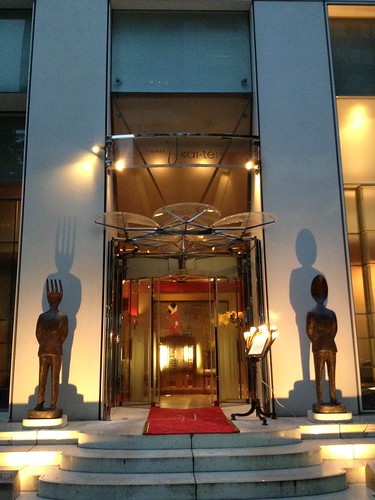
For our last night in Japan, to celebrate the conclusion of our trip and take one last moment to enjoy the glories that are Japanese cuisine, we went to dinner at Ukai-tei Ginza.  This Michelin-starred restaurant was just a few blocks from our hotel and despite our best efforts to get lost (and contrary to Michelin's penchant for gems that are literally hidden), was actually very conspicuous.

Untitled

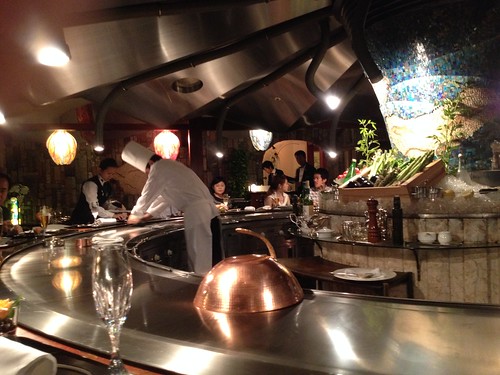
Despite its setting at the base of a tall office building, the interior was rustic and eclectic, even kind of weird.  We later read that the interior was formerly the home of a prominent farmer and had been transplanted there to give the restaurant its distinctive flair.

This was a tepanyaki restaurant, meaning that they specialized in grilled meats.  We were seated at a curved counter with a hot grill separating us from the chefs, who prepared everything right in front of us.


As usual in these situations, we picked a fixed price menu that we could afford, disclaimed all food allergies and watched with delight as the courses came one by one.

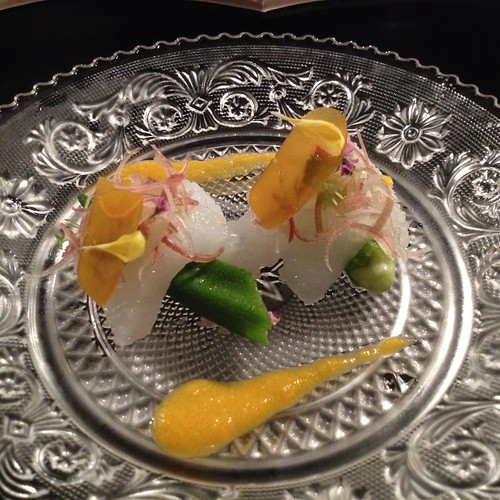
Amuse-bouche with fish and something that might have been okra.
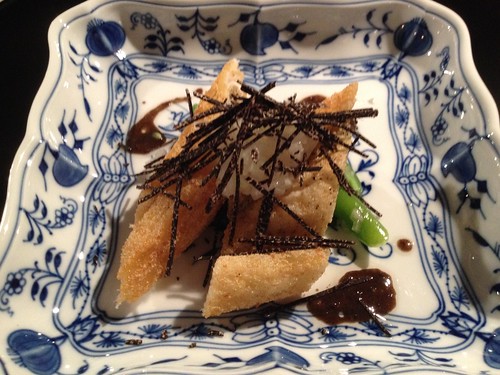
Breaded fish with black truffles
Untitled
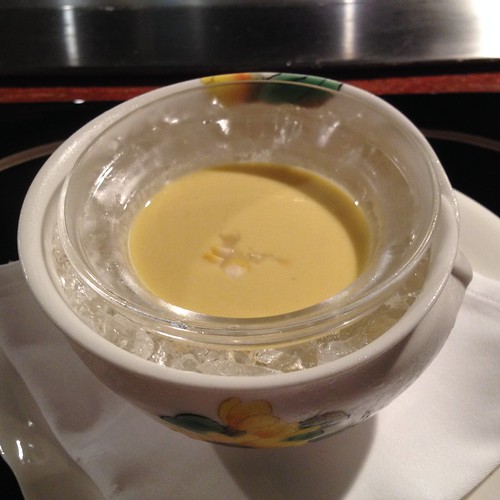
Chilled sweet corn soup
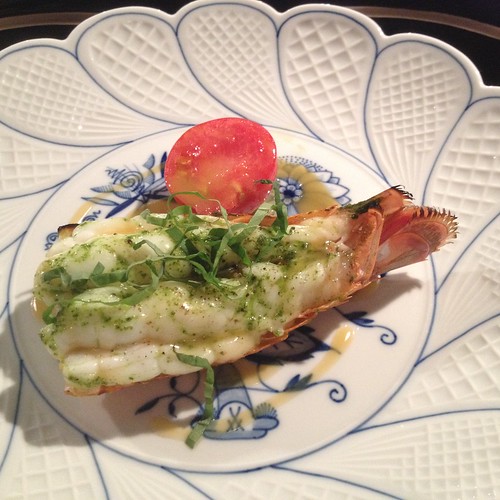
Lobster tail
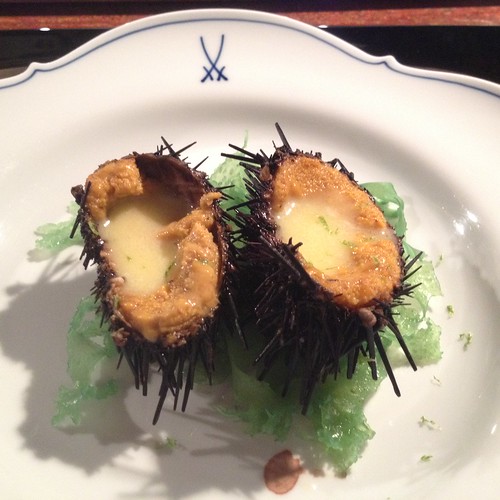
Steamed sea urchin with lime butter sauce and lime zest
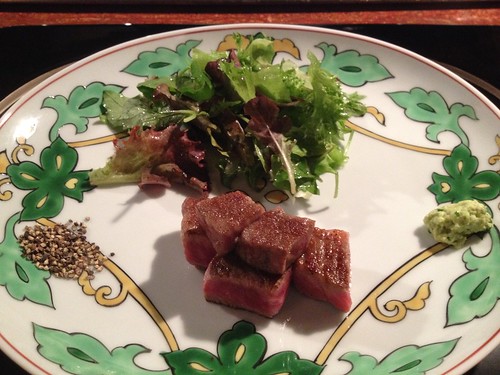
Steak with wasabi, pepper and fresh greens, with red wine soy sauce for dipping
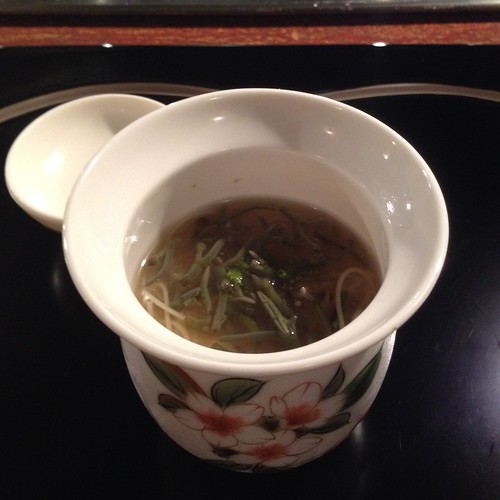
Cold Japanese noodle soup with jelly-covered seaweed and fish broth

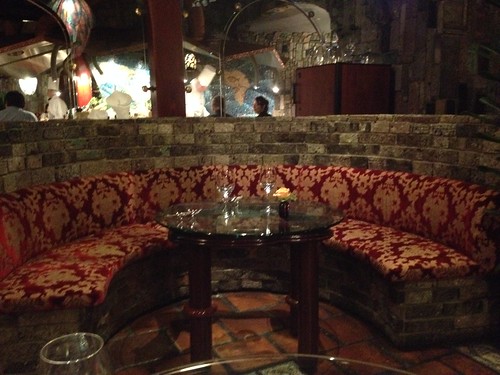
Following the last "dinner" course, our hostess ushered us away from the grilling counter into an intimate and plushly upholstered nook for dessert.

Untitled

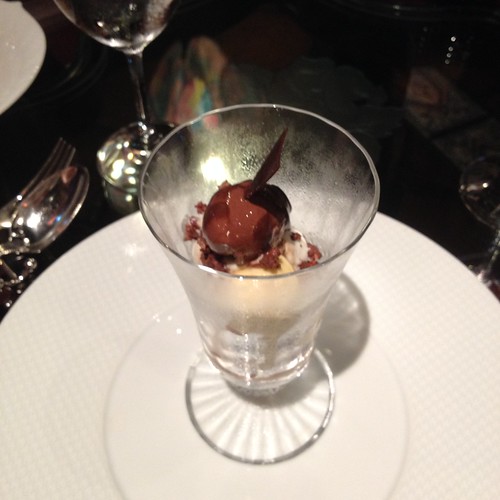
chocolate parfait
 
The dessert nook was unusual at first but ended up being one of the best features of the dinner.  We were very comfortable and had more privacy than we would have had at the counter.  And we felt perfectly comfortable lingering for as long as we wanted talking and enjoying the ambiance.

Finally the hour drew late and we decided to turn in -- after all, we still had to pack for the flight home!  Our hostess accompanied us to the door and out onto the doorsteps, wishing us profuse thanks and fond farewells as we disappeared into the cool evening.


Mount Fuji (Day 2) - Descent

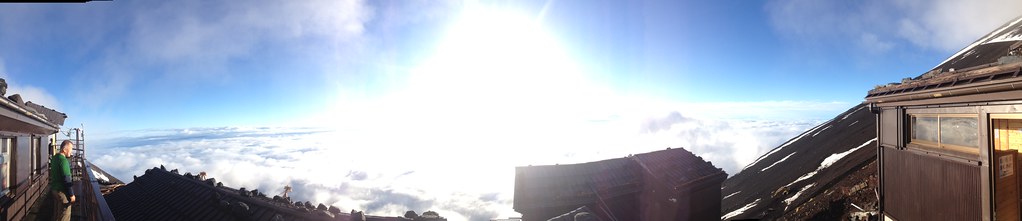
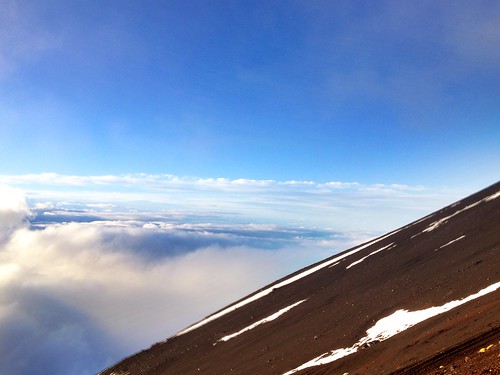
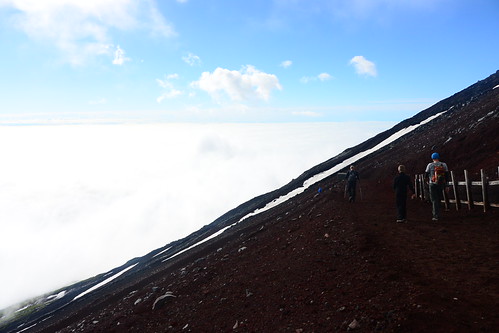
What to people say about labor pains -- about how after you've had the baby the whole ordeal somehow recedes and seems totally worth it?  Whatever it is, that's basically how I felt when the sun rose on Mount Fuji.  I was tired and ornery and uncomfortable as hell, but the instant I walked outside the hut and saw this . . .

Untitled

. . . I knew that all was right with the world.  Despite the scary weather forecast, the sunrise burst bright and glorious before our sleepy eyes.  (Not to worry, though, the summit was still shrouded in cloud, so no regrets at having summited the day before.)

Untitled


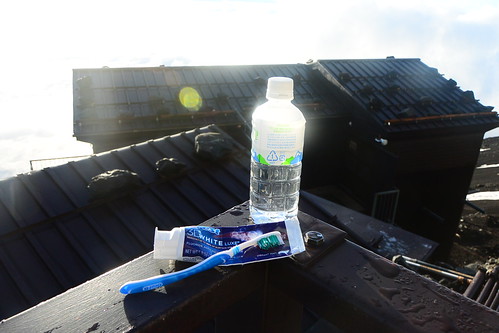
Also toothpaste.  Never underestimate the restorative power of clean teeth!

DSC_3214

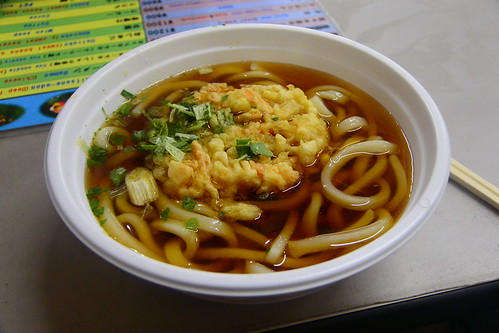
And breakfast!  I opted for udon noodles with tempura fried vegetables.  A warm and hearty breakfast to set the tone for a quick hike down the mountain.

DSC_3216
DSC_3217
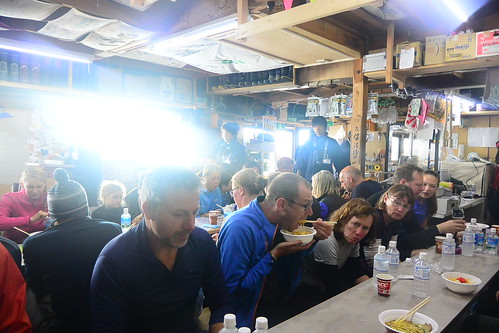
Clean teeth and breakfast are one thing; socializing at 5:00am with a bunch
of strangers is quite another.  I allowed myself to sit quietly for a while and not engage.
With breakfast in our tummies and dry(isn) clothes on our backs, we hit the trail for home.  Eric, Steve and I -- now joined by a 12-year-old named Daniel -- took off running.  Literally.  It was great fun and it did a great job of warming us right up.  I'm pretty sure everyone we passed thought we were lunatics.

DSC_3224

DSC_3219
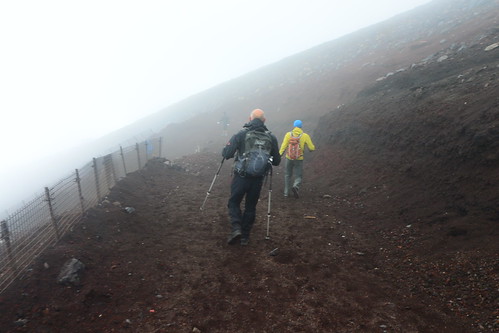
The clear sun didn't last long.  We were soon plunging through thick fog.

DSC_3221

DSC_3225
We went down the Yoshida Trail, which had fewer huts, but it gave us a good vantage
point to see the huts we had stopped at on the Subashiri Trail.
DSC_3230
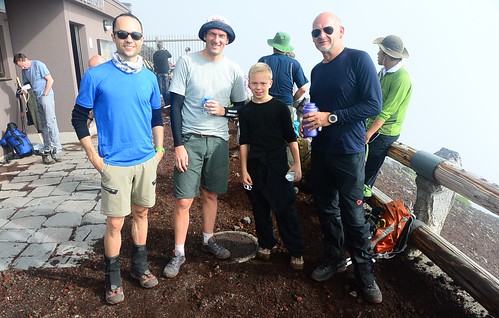
Me, Steve, Daniel and Eric
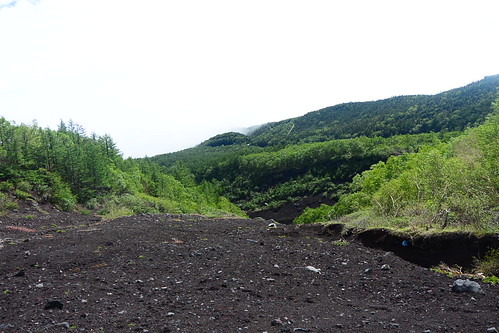
Before long, we were back among trees . . .
DSC_3232

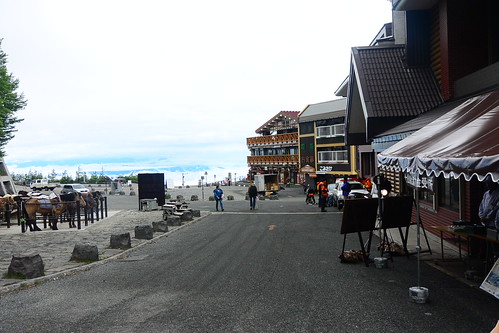
. . . and people.  This was a different Fifth Station from the one where we'd started -- much more developed!  It felt like a miniature city in comparison.

DSC_3233

In clearer weather, we would have had a sweeping view of the valleys and mountains surrounding Mount Fuji.  As it was, just more clouds.

DSC_3237

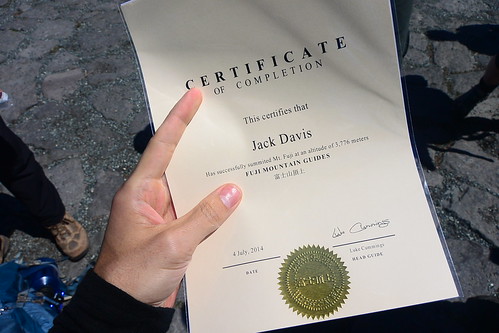
We waited around in the shops while the rest of the group made their way down the mountain.  I charged my phone (and got yelled at) and packed up my rental gear to be returned to the guides.  In exchange for my gear, the guides handed us all a "Certificate of Completion" and then ushered us back onto the buses for the ride back to Tokyo.

DSC_3238
The guides were not so caught up in technicalities as Eric was!
We told Eric he couldn't accept his certificate because he didn't complete the climb...


Once back in Tokyo, I rendez-voused with Amanda back at the hotel, where a glorious hot shower and clean clothes awaited.  We regaled each other with tales of our various adventures (she had her own fair share of trekking across Japan to get to her Buddhist temple retreat -- you can check out her blog here) and wandered out to find our next Michelin-starred restaurant for the night.  Ahh, civilization!!

Thursday, July 3, 2014

Mount Fuji (Day 1-2) - Overnight at the Eighth Station

As neat as it was to be on top of Mount Fuji, our visit was necessarily short.  It was just too cold, wet and windy to hang around up there.  Plus, with no views, it was kind of boring.  So when the Australian began to complain of the cold (he didn't have the extra warm layers that Eric and I had brought), we turned and headed back to the Eighth Station.

Untitled
Untitled
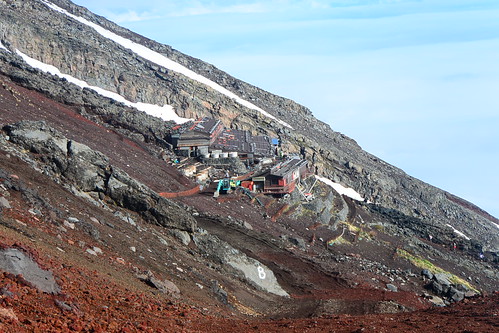
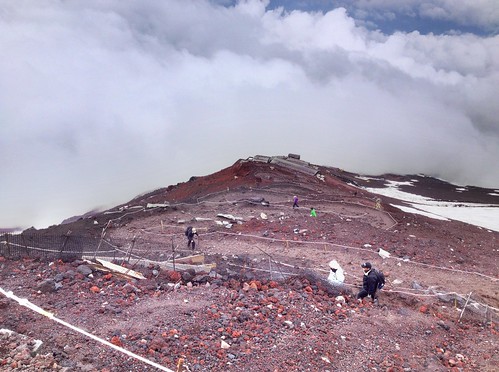
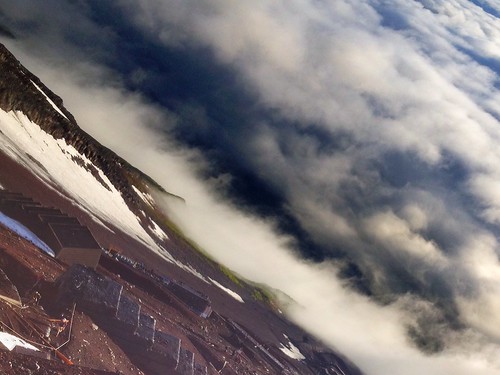
That's the Eighth Station, perched there at the edge of the mountains and clouds.
Untitled

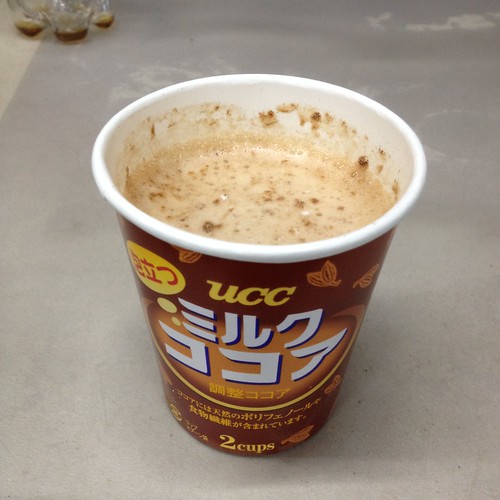
It didn't take us nearly as long to get back to the Eighth Station as it had taken us to get from there to the summit.  We were the first ones to make it to the top and back, and the guides celebrated by buying us our first round of hot drinks.

Untitled
Hot chocolate!
Untitled
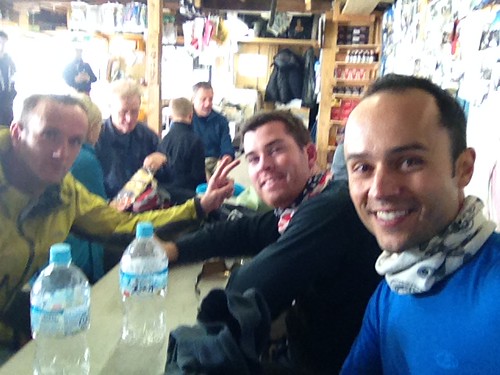
Steve, Scott and me hanging out in the common room

As we sipped our hot cocoa and waited for the rest of the group (or at least enough of a critical mass to warrant starting dinner) to return to the hut, the guides encouraged us to change into clean dry clothes so that the people who ran the hut could show us to our sleeping quarters.

DSC_3206
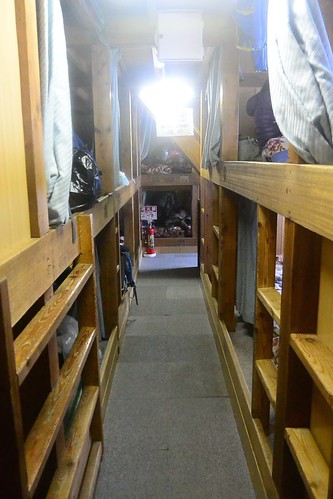
The sleeping quarters consisted of giant bunk beds
DSC_3207
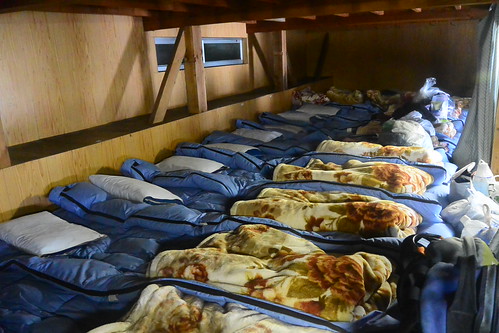
Each bunk platform was filled with rows of down sleeping bags, blankets and pillows.
The guides assured us that we had been given "lots of extra space" because the people running
the hut thought we were "fat Americans".  This was funny because only a few of us were
American, and none of us was fat, but if the stereotype meant more sleeping room,
then I wasn't going to object!
DSC_3204
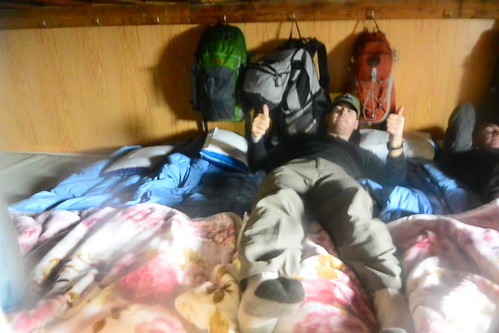
We were each assigned a slot and instructed to hang our packs above our pillow.
Scott, Eric and I were at the end of the row on one of the bottom bunks.

After settling into our bed slot, we came back to the common room, where we sat and talked with the other climbers as they straggled in.  After what felt like forever, dinner was served.

DSC_3209
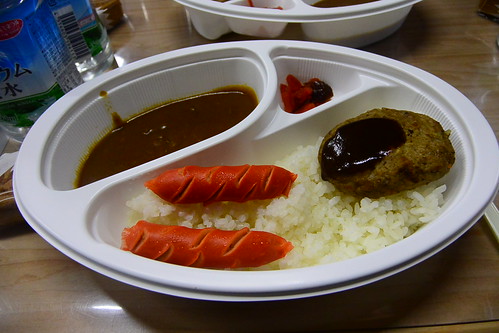
Something involving rice, curry and mystery meat.
As ever in the mountains, the deliciousness of food is directly in proportion to the degree of
extremity in which it is eaten -- this meal was as delicious as any of the Michelin-starred
meals I'd eaten in the previous week in Tokyo!
DSC_3210
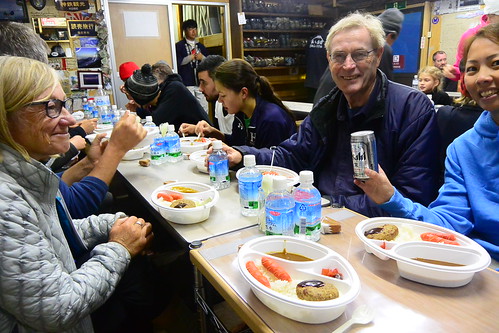
I sat with Wanda (right, from Hong Kong) and Tony and Jessie (both from Seattle)
It wasn't late when we finished dinner -- only around 8pm -- but there wasn't anything else on the program for the night.  Many people, exhausted from the hike or suffering from the altitude, went to bed right away.  Eric and I lingered and talked for a couple of hours, getting to know two American women who were stationed in the military base in South Korea.  They were traveling together and were quite the dynamic, colorful pair!  The Dutchman couldn't get enough.

Eventually, though, we couldn't put it off any longer:  It was time to go to bed [strike the ominous chords], which was easier said than done.  

You may not be able to tell from the pictures of empty sleeping bags above, but when I say these beds were tightly packed, I mean that fat Americans or no, it would have been impossible to have packed us in more tightly.  Think of a mummy . . . 


. . . and a row of tacos . . . 


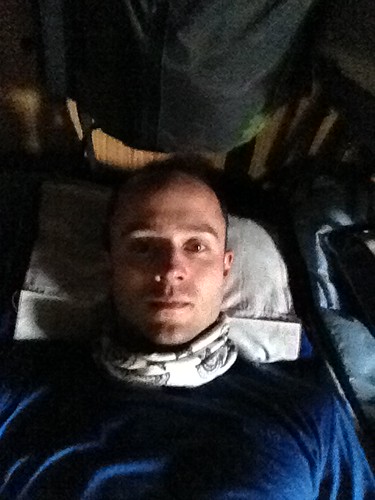
. . . and you might start to have a sense of what was going on.  I had to squeeze myself between the two guys lying next to me, and as I lay there with my arms crossed over my chest, with my entire side-body on each side pressed up against the side of the guys next to me, I felt exactly like a mummy taco.  Add to that the eventually overwhelming heat of the heavy sleeping bags, the fact that my pack was hanging only a few inches above my face (such that if I raised my head even slightly I would hit it), and the puzzling law of physics that permits all heavy snorers to fall asleep instantly even in the worst of circumstances, and you've got the recipe for the most uncomfortable night ever.  

Untitled
Yes, incredibly enough, this beats the freezing night in Puno, Peru,
the sweltering night in Flores, Guatemala, and the night in Rome
when I actually prayed that the snorer beneath me would choke on
his tongue and die, for worst night in the history of me.


Needless to say, I didn't sleep much.  Earplugs spared me the worst of the snoring, and after a while I climbed out of my bag (elbowing the guy next to me in the process) and lay on top of it in my long underwear, where it was cooler.  I practiced deep yoga breathing and tried to stave off the feelings of claustrophobia inspired by the bag hanging over my face.  As I dozed, I contemplated the life choices that had brought me to such a pass and tried not to count the minutes until the sun rose and we could escape back down the mountain.


Mount Fuji (Day 1) - Ascent and summit

When we decided to come to Japan this summer, I told Amanda that climbing Mount Fuji was my top priority on my list of must-do activities.  In fact, it was my only must-do activity.  Why?  Well, why not!  Although not the tallest or most difficult climb in the world, Mount Fuji ranks among the most famous peaks in the world and may be the most iconic:  the perfect symmetry of that volcanic cone is almost synonymous with Japan, figuring prominently in the physical, cultural and spiritual worlds of Japan.

Besides, everyone's doing it.  Each year more than 300,000 people scale the slopes, and even more flock to its lovely foothills to catch a glimpse.  And with stories abounding of 80-year-old women and little children making it to the top, it seemed a shame not to go myself (yes, I'm willing to compete with old women and children).  Especially when the best reason anyone could give me for not climbing the mountain was that "after a while it's just really steep and rocky."  I mean, doesn't "steep and rocky" basically describe any mountain?

Old women and children notwithstanding, I knew I would need to take this climb seriously.  With an altitude of 12,380 feet (3,776 meters) above sea level, it's a legitimate mountain, and the conditions can be treacherous.  Plus, I don't speak Japanese and most Japanese don't speak much English -- I didn't want to get into any trouble and find myself unable to get help.

So I did some research and discovered the Fuji Mountain Guides, a mountain guide operation founded by some young American guys who had grown up in Japan.  The details offered on the website inspired confidence, and the available climb dates fit my itinerary, so I signed up for a two-day climb and a bunch of rental gear.

On the morning of July 3, I met up with the guides and the rest of our group in the lobby of the Keia Plaza Hotel, not far from Tokyo's sprawling Shinjuku Station.  It was easy to pick out the climbers, for the most part outdoorsy looking folks sitting bleary-eyed on the fancy couches with hiking boots and backpacks.  This made it easy for the guides to round everyone up and have us sign the obligatory waivers and listen to the plan for the day.

Normally, they explained, we would climb most of the way to the summit on the first day, spend part of the night in a mountain hut, and then finish the ascent in the wee hours in order to be on the summit for sunrise.  Not this time, though.  The latest weather reports predicted worsening weather today and terrible weather tomorrow -- not only would we not see the sunrise, but the windy, wet conditions would likely make it unsafe even to attempt the final ascent.  So to make the best of it, the guides proposed that we push straight for the summit on the first day, go down to the hut for the night, and then finish the descent in the morning.  Sounded fine to me!

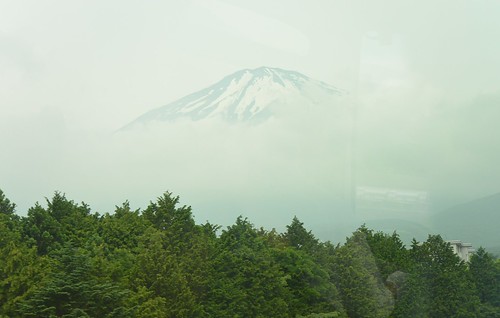
The mountain trails are divided into eight "Stations".  Most climbing groups start at the Fifth Station on whatever trail they're climbing and sleep at the Eighth Station (the last before the summit).  It took us about three hours by bus to get from Tokyo to our fifth station.  The clouds were pretty thick, but as we got closer to the mountain occasional breaks would allow glimpses of the mountain floating ghostlike above the countryside.

DSC_3151

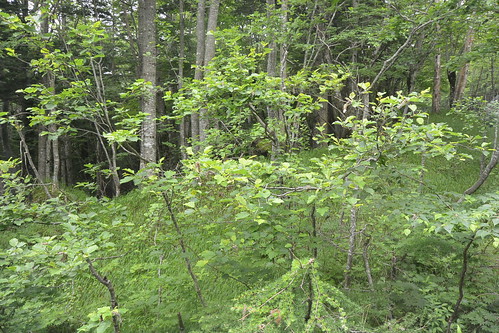
Soon we found ourselves winding our way through the foothills, up the wide base of the cone.  The forest was lovely and dense.  Our guide explained that the forest was named (rather redundantly) the Forest of Trees, and that it was the top suicide spot in Japan.  Apparently the Japanese believe that your spirit goes to high places after death, so why not make it easier on yourself by dying in a high place to begin with?

DSC_3154

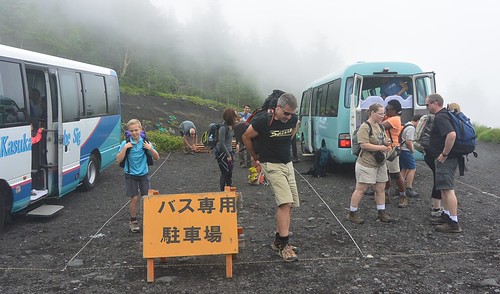
We made it through the Forest of Trees without any suicides (though our sputtering bus seemed to have been considering it) and got to the Fifth Station.  Everyone climbed out of the buses into a chilly, misty world.

DSC_3155

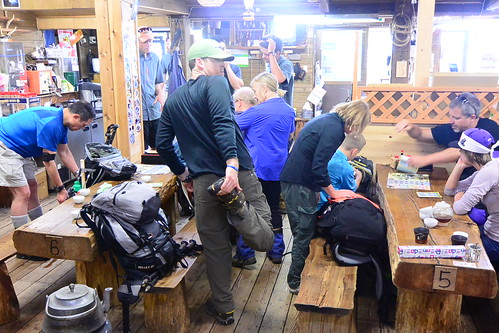
We regrouped in one of the Fifth Station huts.  We were admonished to take advantage of the free toilets (from here on out, they'd cost $2 a visit) and cheap water (only $4 for half a liter, instead of $5).  People stretched, put on additional warm layers and repacked their gear.
DSC_3159
I love how I can look at an early photo like this an remember how, when I took it, I didn't
know any of these people, but now I do know them and share some great memories with them.
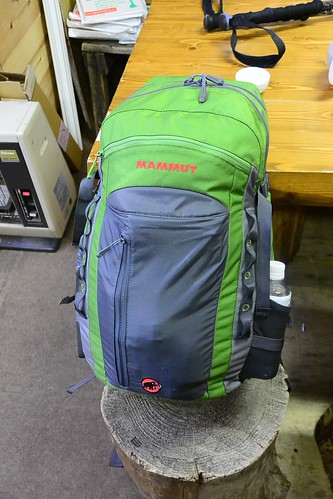
 I packed my gear for the first time.  Not wanting to fill my luggage with bulky climbing gear, I basically only brought shoes, long underwear and a gazillion granola bars from home.  The rest of the gear -- backpack, gaiters, waterproof jacket and pants -- I rented from the guides.  I had brought all my stuff in a large nylon shopping bag, and it was a relief to finally look like a serious hiker!

DSC_3158

After one last pep talk from the guides and instructions on where the fast group should stop and wait up for the rest of the group, we began our ascent.
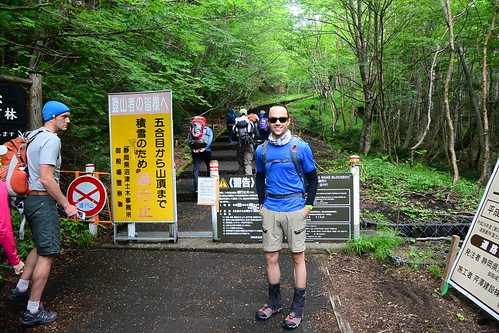
DSC_3163
We climbed the Subashiri Trail.  The guides explained that it was longer than some of the
other trails, but also less difficult and less crowded.
DSC_3165
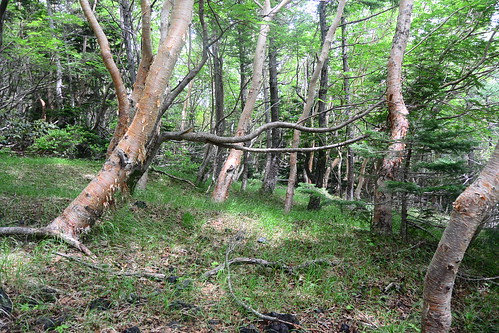
I don't think I've ever hiked through a birch forest before.
DSC_3166
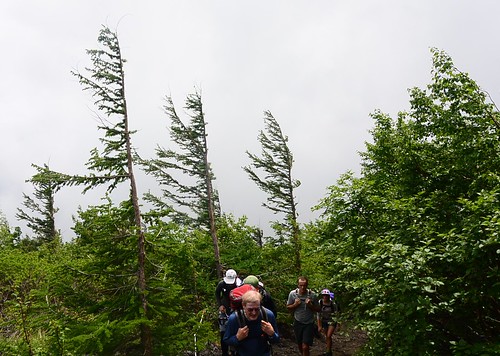
Wind blow in a particular direction much?
DSC_3167
As the trees started to thin, so did the group.  Pretty soon it was just three of us -- me,
an Australian guy, and a Dutch guy -- who led the way.  We became good friends.
Untitled
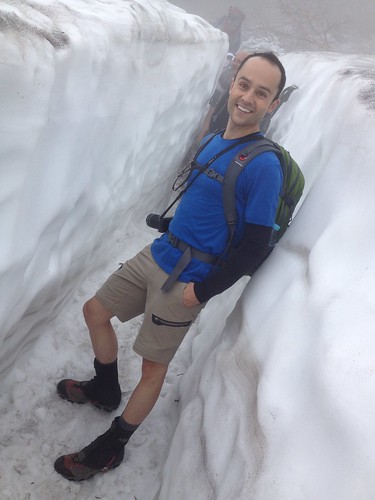
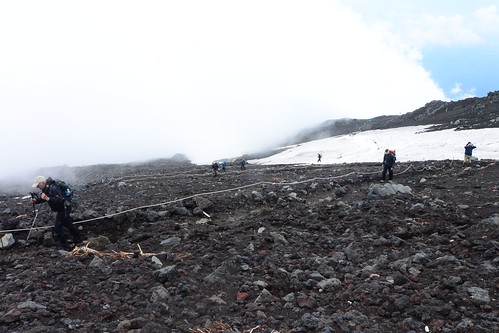
Most of the trail by now was clear of snow, but big drifts still remained
in some of the ravines.  Fortunately park rangers had dug paths.
DSC_3179
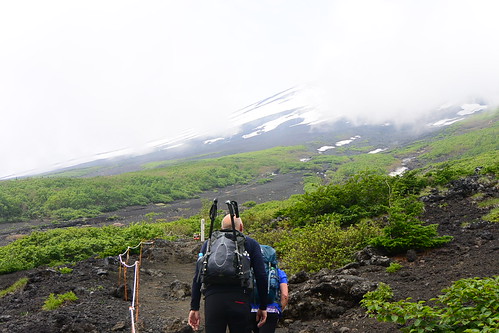
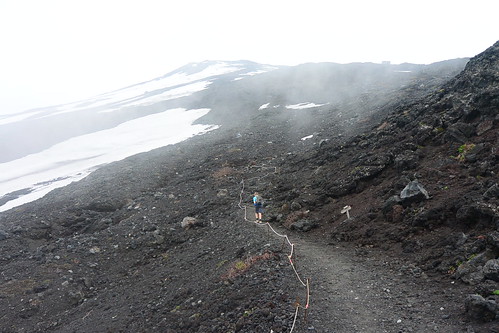
After a while the snow and trees gave way to steep, rocky slopes.  
DSC_3182
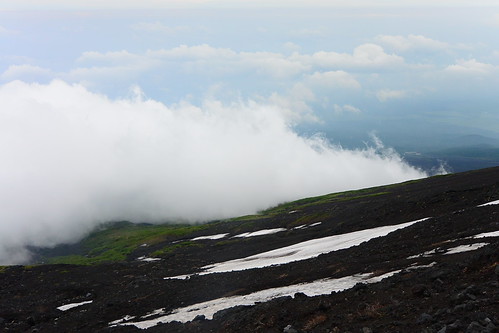
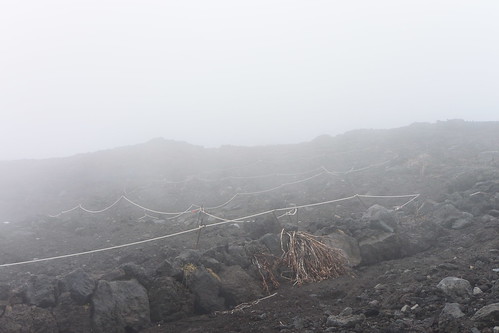
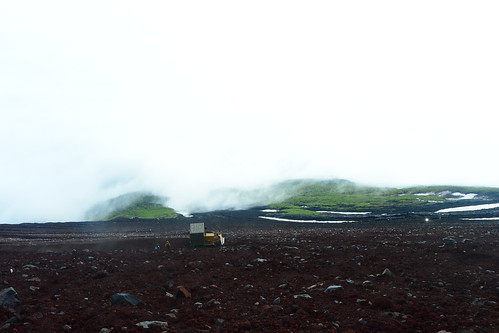
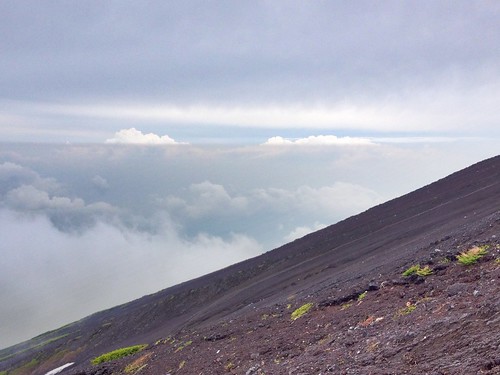
The clouds hugged the mountain, making it tough to see more than a few feet at a time for
most of the hike.  Every once in a while the breeze would clear a hole through which we
could almost see the green plaines below.
DSC_3186
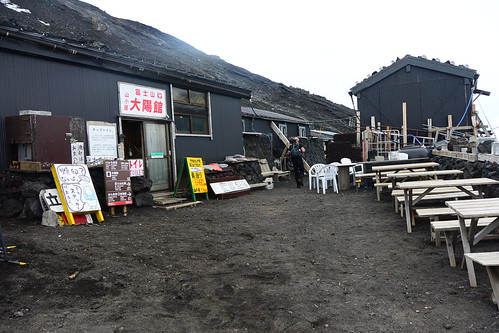
This is one of the huts where we waited for the rest of the group to catch up.  Most of the huts
offered toilets, water and some form of hot food (mostly noodles), all exorbitantly priced.
 
DSC_3195
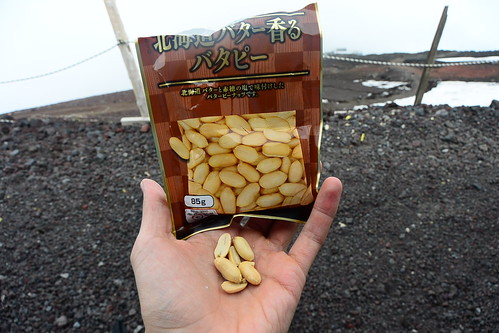
I didn't need food from the mountain huts -- I had brought enough granola bars, dried fruit, and
nuts to feed a small village.  A good thing, too!  The climb was demanding enough that I ate a
little at each stop to sustain my energy.
DSC_3188


Untitled

DSC_3189
As we neared the top, the weather got even worse and the trail even steeper.
Untitled
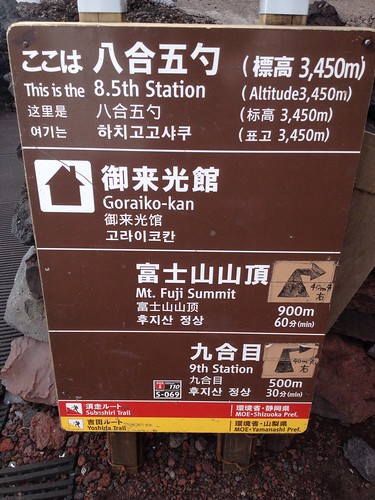
60 minutes to go less than a kilometer?  Normally we'd scoff, but
in this terrain that ended up being about right.  The key, I found,
was to set a pace that hovered just below being out of breath.  At that
pace, and with the occasional sugar boost, I could go for a long time
without needing to stop.
Untitled
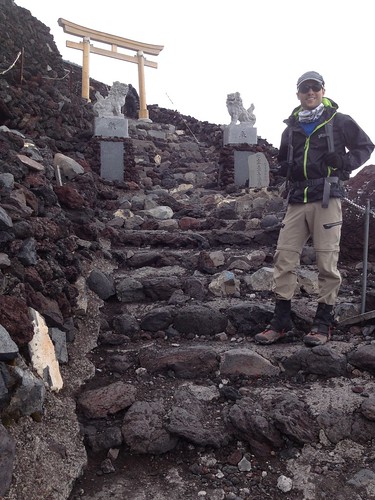
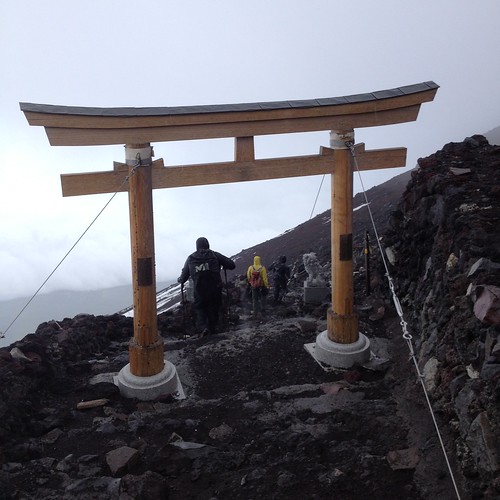
Almost there!  The mountain is sacred in the Shinto religion, so
the Shinto shrine gates marked the entrance to the summit.
Untitled
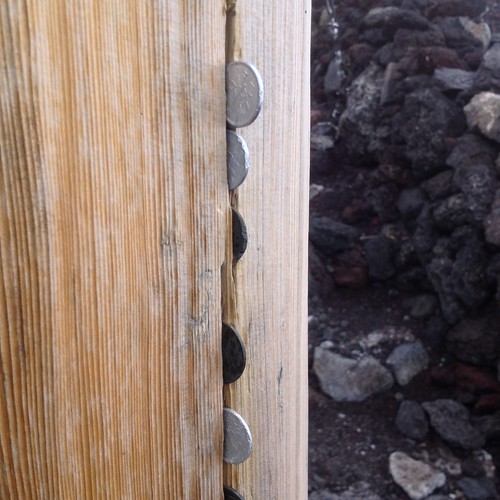
Hikers had filled every crack in the gate's posts with coins.
Were they making wishes or just trying to lighten their load?

The climb was not easy.  Between the steepness, the weather, and eventually the altitude, it took determination and effort to keep going.  But finally we made it!  We passed through the Shinto gates and crested the rim of the crater; the deep bowl of the crater opened before us.

DSC_3199


The wind and rain were even worse at the top, and it was pretty miserable (I quickly donned the last of my warm clothing and all of my rain gear).  We couldn't see anything but the rocks in front of us, but still -- the summit!

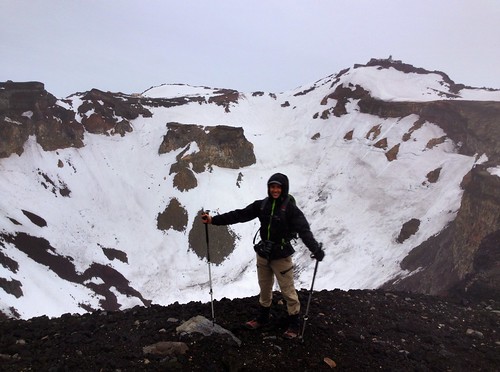
Untitled

Well, technically not the true summit -- the true highest point of the mountain was on that ridge behind me in the photo above.  But the path to that ridge was covered in sheer ice, and none of us had brought our crampons and ice picks.  Standing on the crater was enough for me and Steve (the Australian), but not Eric (the Dutchman).  Eric, we had learned on the hike up, was a serious mountaineer (he's doing Everest next year) and refused to say that he's "climbed" a mountain unless he'd gotten to the true highest point.  Crestfallen, he said, "Oh well, this was a nice training hike.  I'll have to climb Mount Fuji some other time!"
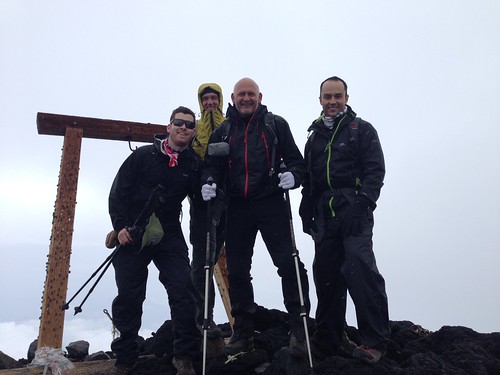
image_3
From left:  Scott, Steve, Eric, me
We took this picture for Eric, so that it would look like he was actually on the top.
He just shook his head and said, "But I know it's not true!"  Poor Eric!
I have to say that for as much satisfaction as I got from the physical accomplishment of climbing the mountain, the real fun of the trip came from the people I climbed it with.  Eric, Steve and I were the fastest in the group, so we formed a natural little team as we climbed together.  There were probably ten years' difference in age between each of us (I was the youngest, then Steven, then Eric), but our senses of humor, level of competitiveness, and relish for the activity helped us form a quick friendship.  There were others, too, that we got to know along the way, such as Scott (in the picture above), who is from Nashville and was climbing a mountain for the very first time in his life.
The camaraderie we had on the mountain is one of my absolute favorite things about international travel -- people from so many different countries and cultures coming together in a place that is foreign to all of us, but through the process of experiencing that new place and getting to know each other, we sense our common humanity and build a new community of friendship.