Tuesday, June 24, 2014

Seoul (Day 2) - Changdeok Palace and Huwon Garden

According to our guide books, Seoul has a couple of palaces that are really worth visiting.  We had originally planned to devote today to visiting two of them . . . but then we spent half the morning blogging about yesterday's activities and then having another multi-pastry breakfast at the Paris Baguette Cafe down the street.  While breakfasting, we discovered that (1) the principal palace was closed on Tuesdays, and (2) the Changdeok Palace's famous Huwon Garden could only be visited as part of a guided tour, and the last English-language tour was leaving sooner than we could walk there.   So much for planning things on the fly!
We decided to make a run for the garden tour (by all accounts it was a "must do"), so we snarfed the last of our pastries and kiwi milkshakes and hurried to the nearest taxi stand.  At this point we learned a valuable lesson about guide books:  Amanda and I have both used the Lonely Planet guide books for years, but we always wonder if others would be better.  This time Amanda got the Lonely Planet for Seoul, and I got the green Michelin guide (different from the red Michelin guide).  So far the Michelin has sadly underperformed in pretty much every way, while the Lonely Planet has lived up to the brand's solid reputation.  But when we got into the taxi and proceeded to murder the pronunciation of the palace's name and then handed the Lonely Planet to the driver with plenty of (un?)helpful gestures, all we got was a blank stare.  I pulled out the Michelin on the theory that our driver might be able to understand a different set of English words, only to discover that, lo and behold, Michelin had thought to print place names and addresses in Korean as well as English.  Of course the letters were tiny enough that our cabby literally had to pull out a magnifying glass from the glove compartment in order to read it, but read it he did -- and with a little grunt of understanding he set off through the city.  (Take note, Lonely Planet. I expect more Korean-language listings in the next edition!)

Anyway, we got to the Changdeok Palace without further ado and purchased our tickets for the garden tour.  Thanks to our speedy cabby, we still had about 40 minutes before we needed to be at the rendez-vous point for the garden tour, so that gave us time to explore the building complex of the palace.

The Changdeok Palace was built in 1405 as a secondary palace for the king.  According to the signs, this was necessary to bring balance to the city -- now there was a palace on the west and a palace on the east.  I could just imagine how well this went over with the common people:  

King: [to the people]  I need to raise taxes and force you labor in building a fancy new palace.

People: [to the king] Boo!

King:  People, believe me, I don't want a new palace -- I need a new palace to balance out the fact that I've already got another one on the other side of town.  It'll be a win for everyone!

People:  Oh, well, that makes perfect sense.  Here's our money and labor!"

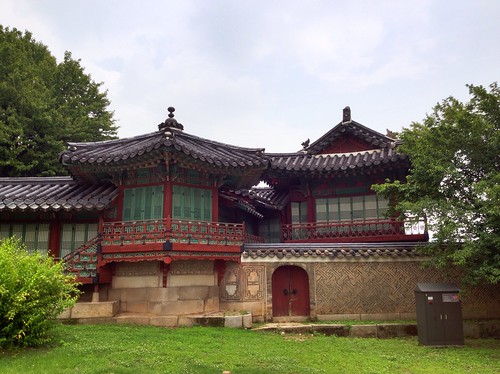
In any event, the palace was built and is now a prime example of the Korean design principles harmonizing nature, geographical positioning (mountain in back, river in front), and the manmade palace and gardens. Over the centuries, portions of it were destroyed and rebuilt. It became a UNESCO World Heritage site in 1997.
DSC_2521
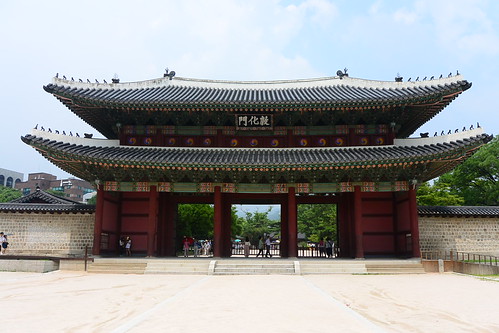
The Great Gate
built in 1412 and restored in 1609
DSC_2523
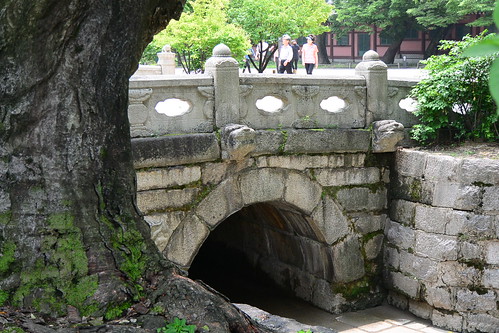
Geumcheongyo Bridge
built in 1411
DSC_2527
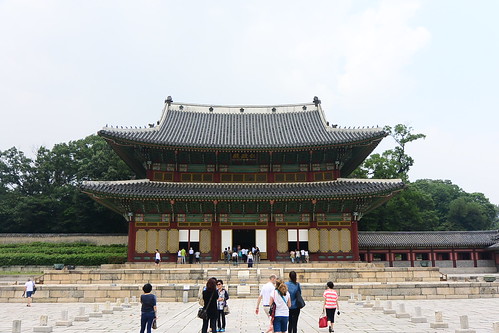
Courtyard of the throne hall
DSC_2528
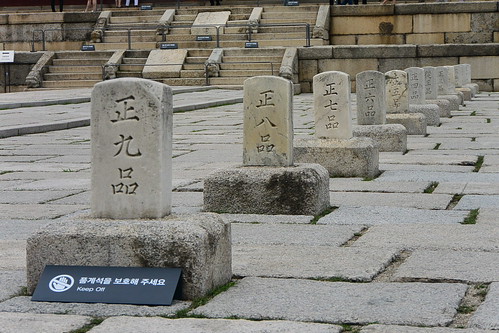
Stone markers designate where various officials stand during state ceremonies
DSC_2530
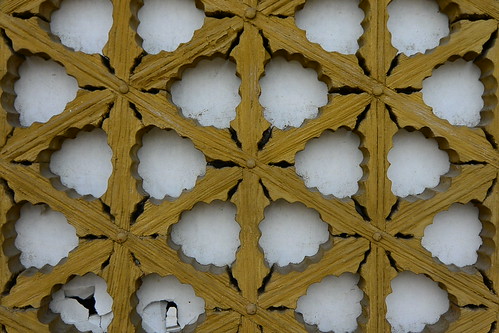
Detail of the latticework on the outside of the rice paper windows
Untitled
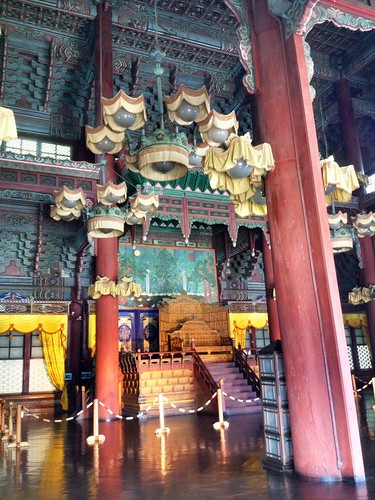
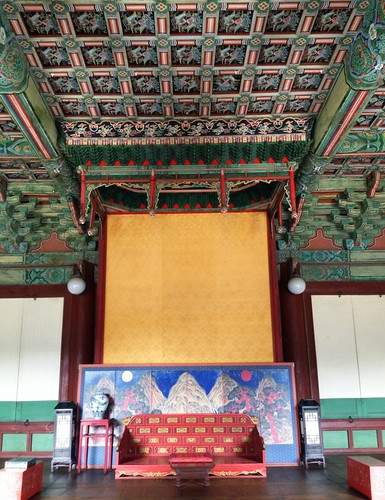
Interior of the throne room
built in 1405 but later restored with Western elements
Untitled
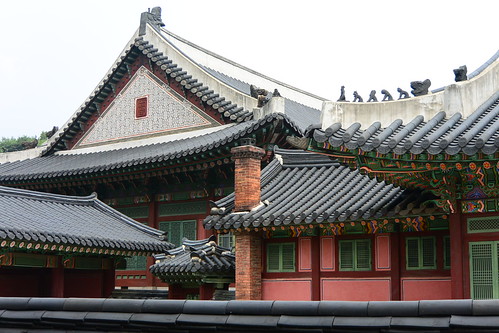
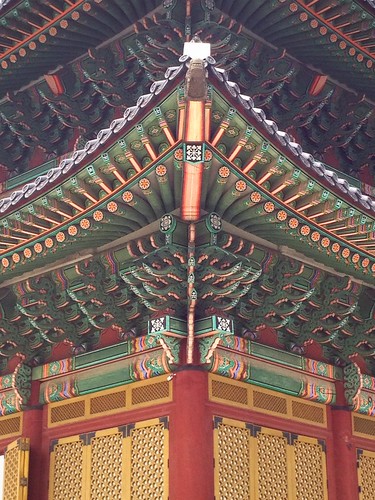
Eaves detail of the throne hall
Untitled
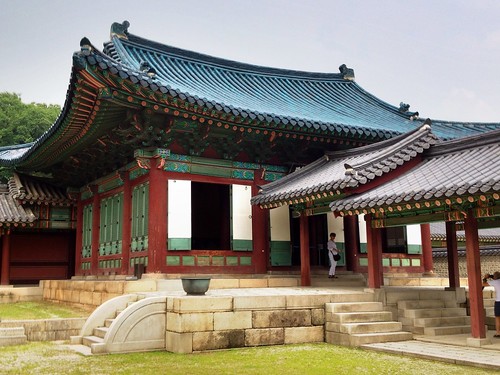
Administrative hall; the only one to have a blue tile roof
Untitled
Untitled
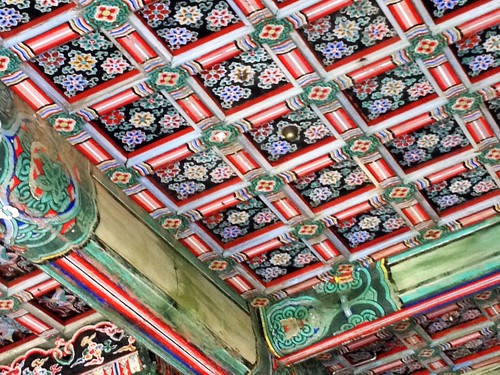
The colorful ceiling is typical of public buildings.
The colors represent the various elements.
Untitled

DSC_2531

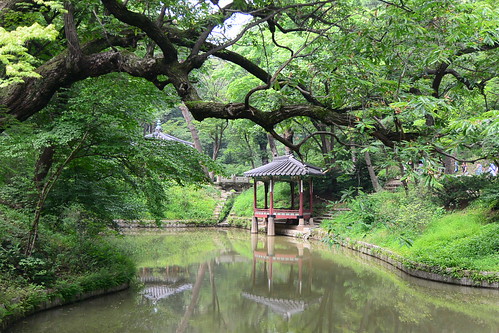
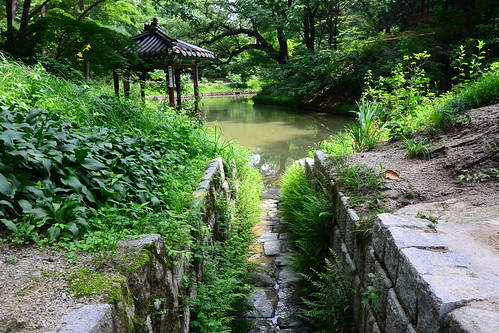
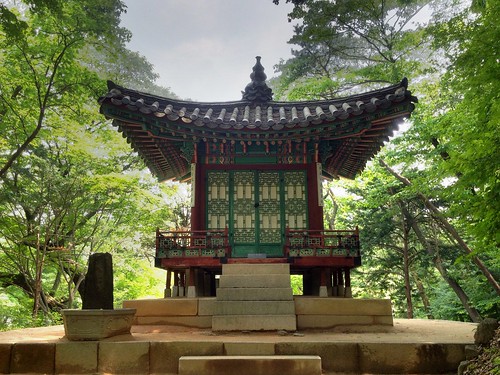
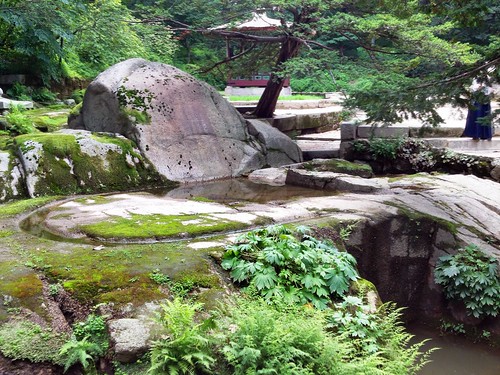
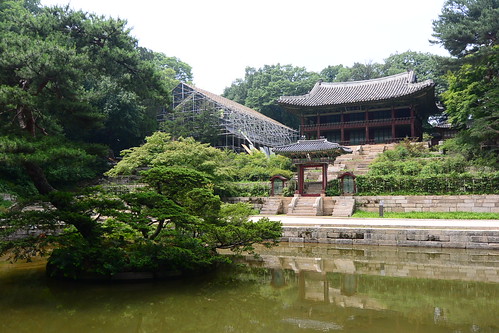
The real draw of the Changdeok Palace is the Huwon (a.k.a. Secret) Garden. Spreading out behind the palace in the middle of Seoul, the garden is a vast, unspoiled park consisting of woodlands, water features and tastefully placed pavilions where the royal family would retire for poetry-writing parties, archery and sailing wine-glasses down the stream (because apparently that's a thing). Given how highly the garden was praised, I came in expecting something spectacular -- on the order, maybe, of Versailles or something -- but our guide quickly advised us to set our expectations lower. And she was right. The garden was indeed lovely, but in a natural, understated sort of way.
DSC_2533
The square pond represents the earth, and the circular islet represents the heavens.
On the hill is the royal library.  The three gates are for the king (center) and his ministers.
DSC_2534
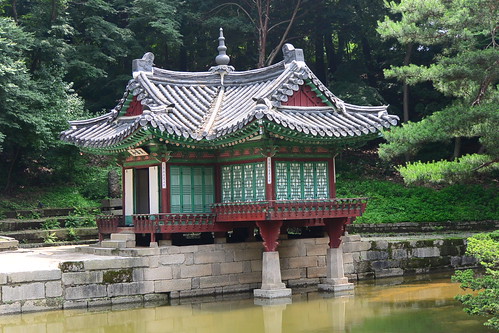
Lotus pavilion. With its "feet" in the water, the pavilion adds the human element
to the earth and heavens of the pond/islet design.
DSC_2535
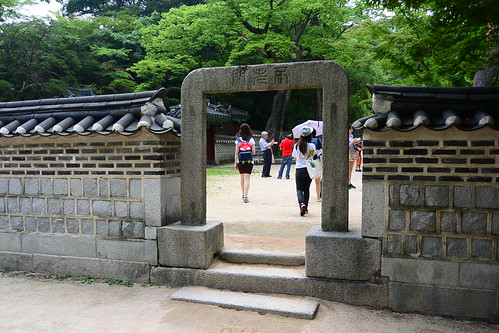
This gate is carved from a single large piece of stone.
Apparently it has properties that will lengthen your life if you cross through it.
DSC_2537

DSC_2539

Untitled

Untitled
Part natural waterfall, part manmade fountain.
This is where the king and his friends would float their wine glasses down the stream.
Was it really a game, or were they just littering?
Untitled
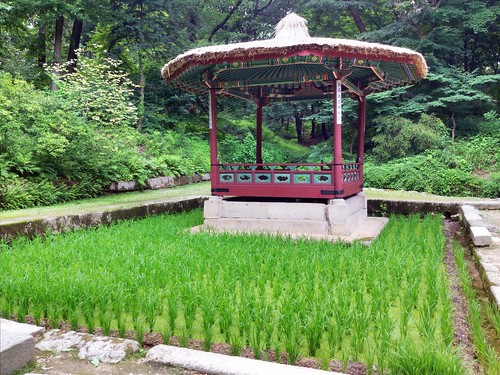
The king's very own rice paddy.
Untitled
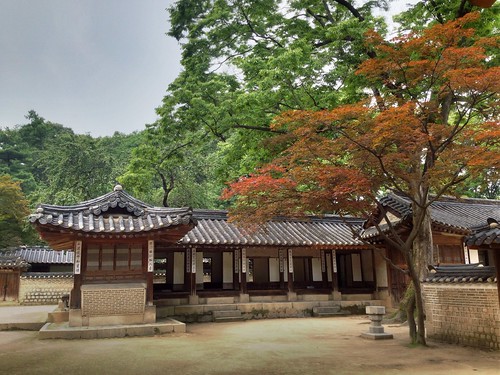
To get in touch with how "the people" lived, the king built this house modeled after
a nobleman's residence.  Makes me think of Marie Antoinette's Petit Trianon.
DSC_2541
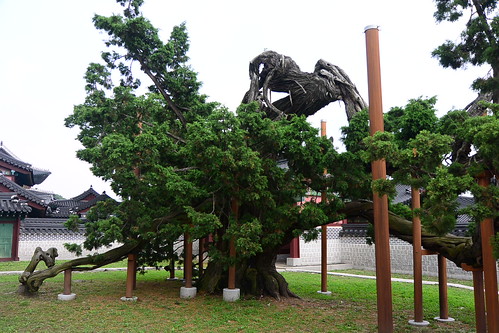
This Chinese juniper tree is estimated to be approximately 750 years old!

Monday, June 23, 2014

Seoul (Day 1): Cheonggyecheon and Myongdong - modern Seoul

The old, traditional houses of Bukchon are lovely, but most of Seoul is super urban and very modern. It's a fun, vibrant city that feels surprisingly familiar and very clean.

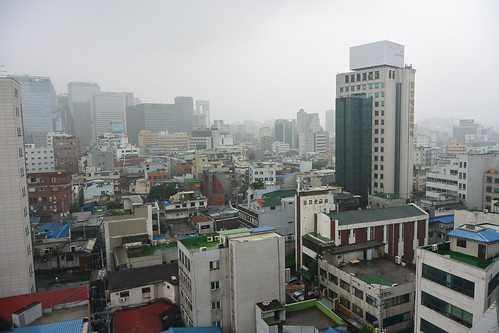
DSC_2461
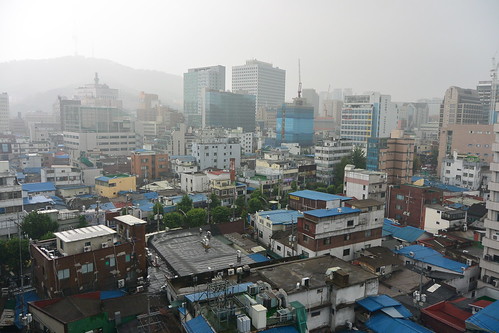
View from the hotel balcony, looking southeast.
DSC_2462
Hotel view looking southwest.
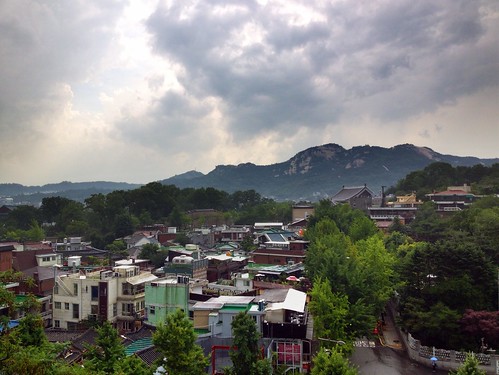
Untitled
Hilltop view in Bukchon neighborhood
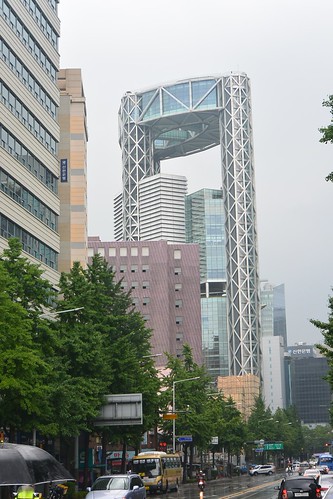
DSC_2477
Samsung owns this building.
I feel like it should be the setting for the climactic
fight sequence in an action movie.
DSC_2479
DSC_2515
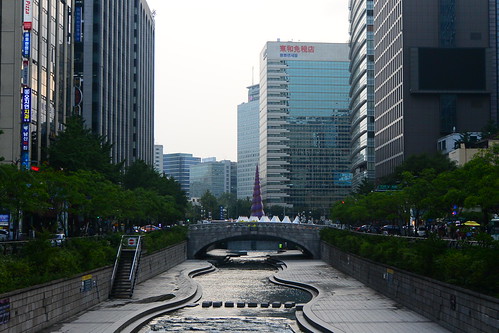
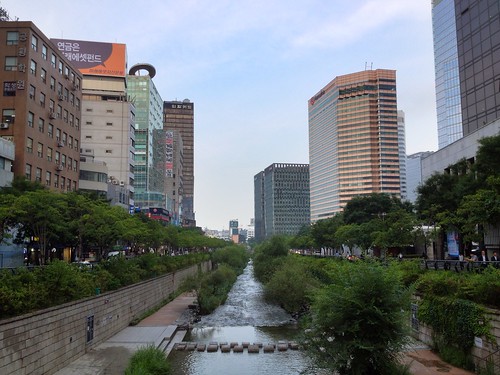
This river walk apparently used to be covered by a highway.  It's lovely now.
Untitled
DSC_2516
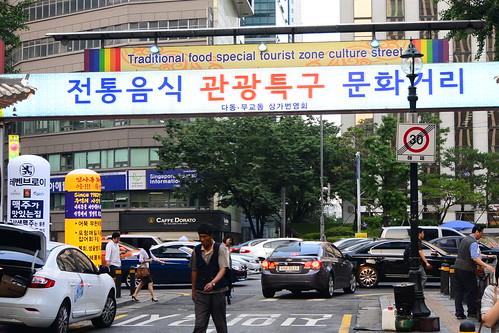
I love how the English signs make sense, but only kind of.
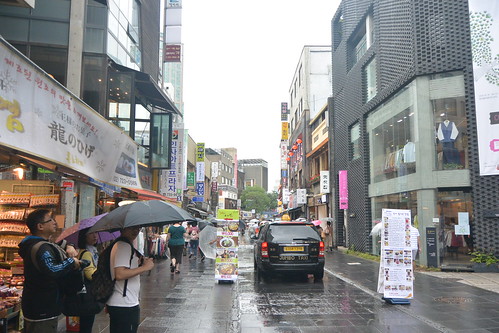
DSC_2520
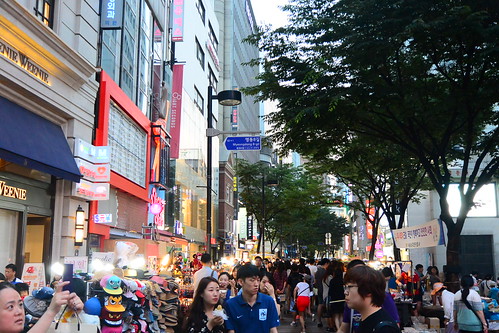
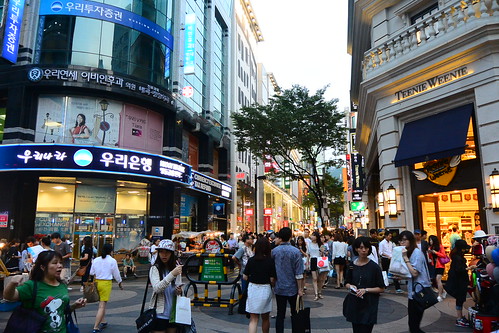
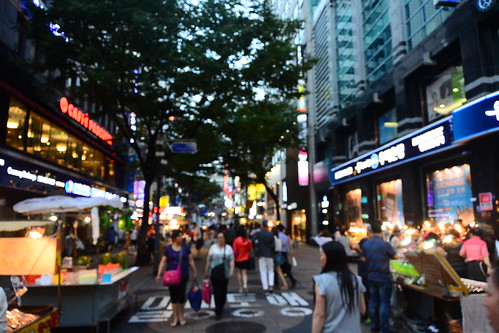
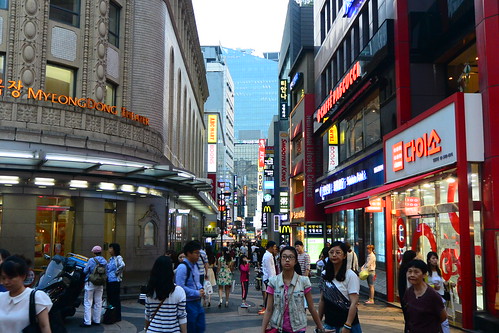
Standing at the intersection of two busy pedestrian streets in the lively
shopping district of Myongdon.  Here's a view to the right.
DSC_2517
And a view straight ahead.
DSC_2518
To the left.
DSC_2519
And behind.
I love the cacophony of colors and signs.

Seoul (Day 1): Insa-dong and Bukchon - strolling through Seoul's traditional neighborhoods

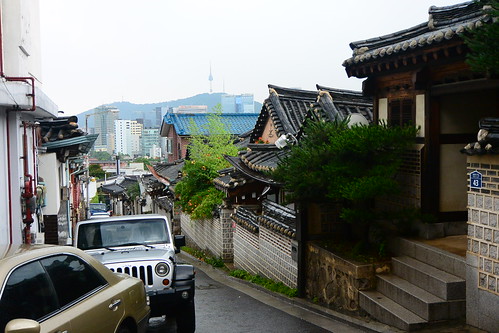
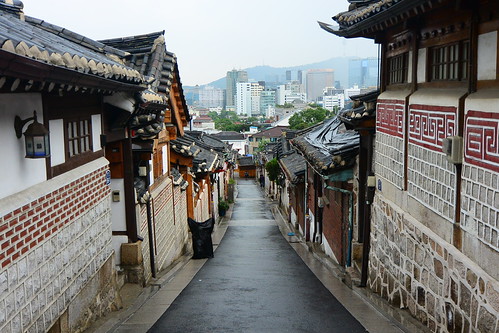
Between meals on our food tour, Veronica led us through some of the historic neighborhoods of Seoul.  Most of the traditional architecture in Seoul was destroyed during the wars and subsequent modernization, but here the lovely old residences have been preserved and can still be appreciated.  

DSC_2493
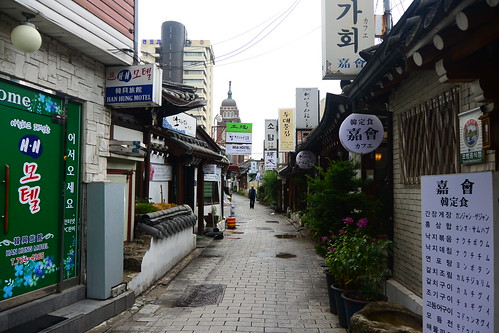
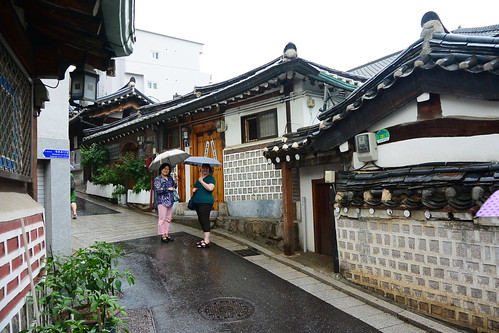
A street lined with traditional houses in Insadong.  The traditional houses are
expensive to maintain, so most of them have now been converted to restaurants
or guest houses.  

DSC_2492
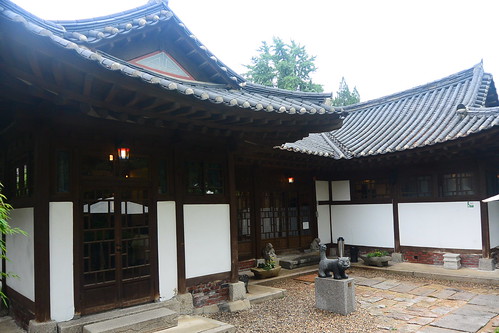
A famous and well-preserved traditional residence. It now houses a French restaurant. 
6

DSC_2496
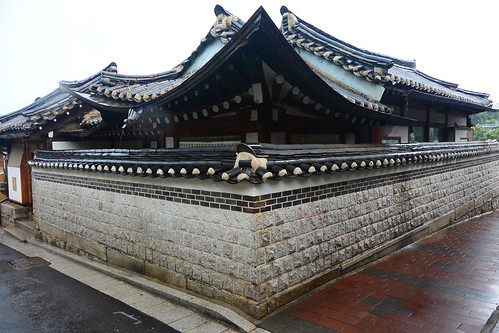
Bukchon is a more residential neighborhood, with many old houses are still
residences.  Newer houses are built in the traditional style.
DSC_2494
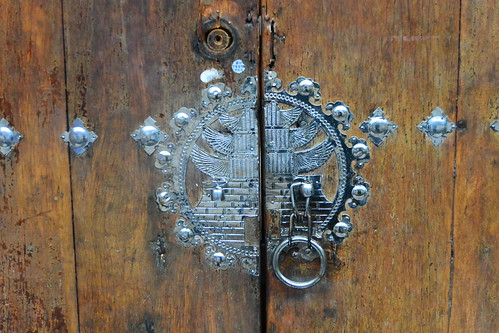
Detail of a door latch
DSC_2498
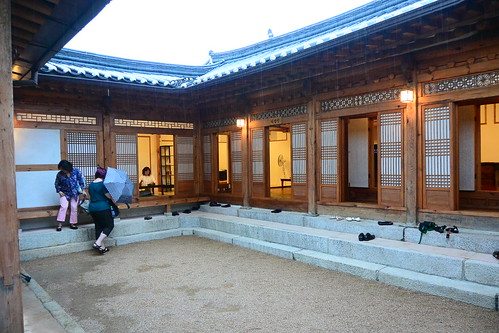
Traditional houses are built around a courtyard
DSC_2499
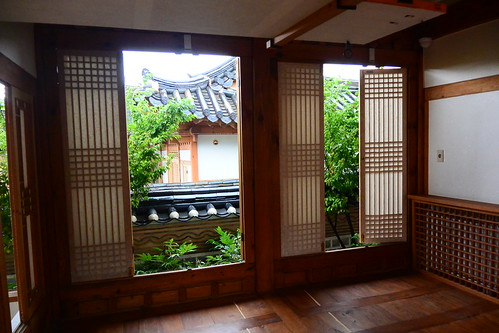
The rice-paper windows and doors are lovely, but I would miss being able to see out
DSC_2502

DSC_2503
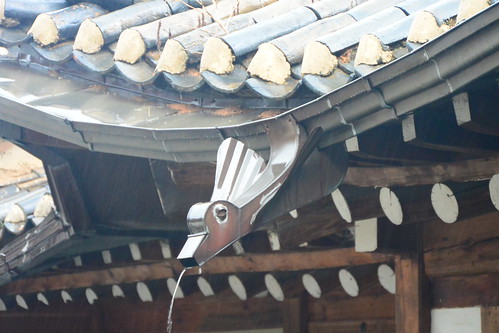
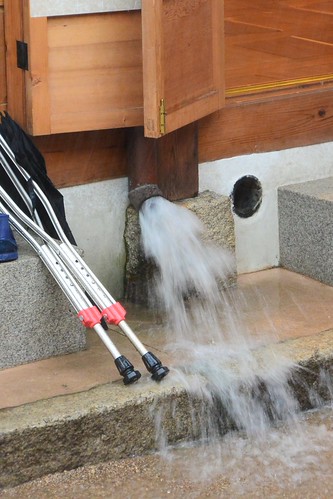
With all the rain, we got to see these neat spouts in action
DSC_2506
Jeep!
DSC_2507
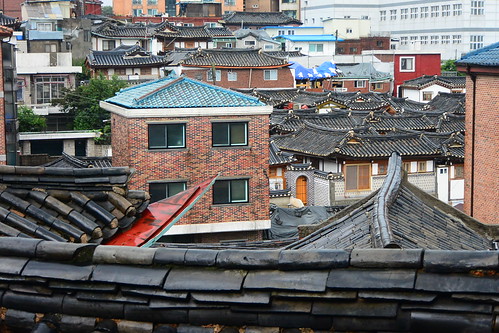
I love the juxtaposition of this traditional street in the foreground with
the skyscrapers of modern downtown in the distance
DSC_2504

Seoul (Day 1) - Stuff we saw while we weren't eating or getting rained on

We may have spent most of the day eating, but that doesn't mean we didn't see anything else.  Here are the highlights:

SUBWAY
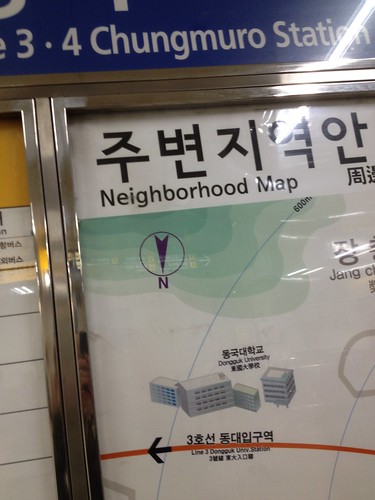
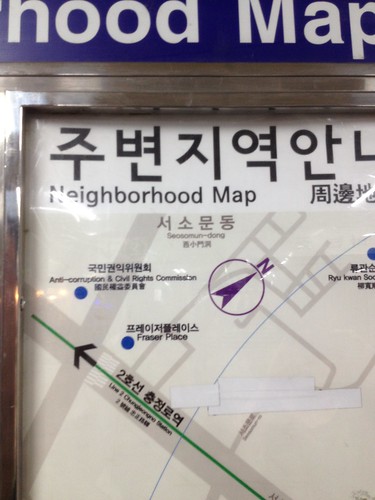
The Seoul subway is impossibly clean and surprisingly easy to navigate, hindered only by the fact that every single map seems to be oriented differently with respect to North.  Keeps you on your toes, I guess.


CITY HALL
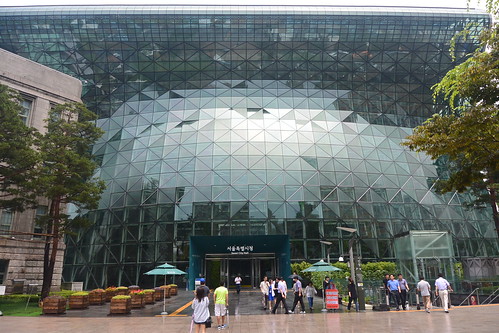
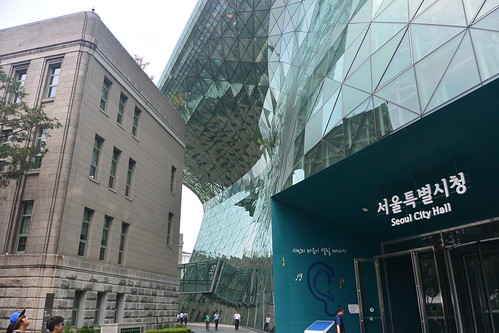
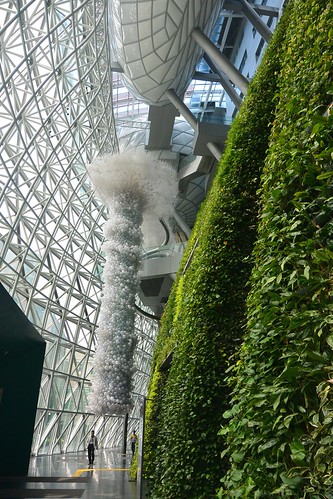
The guidebook described the City Hall building as a "tsunami of glass", and that seemed about right.  It's a very cool building.

DSC_2463

DSC_2464

DSC_2466
 
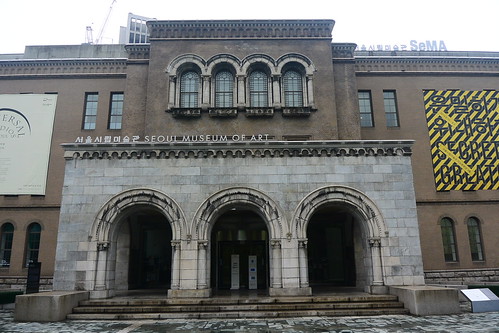
SEOUL MUSEUM OF ART
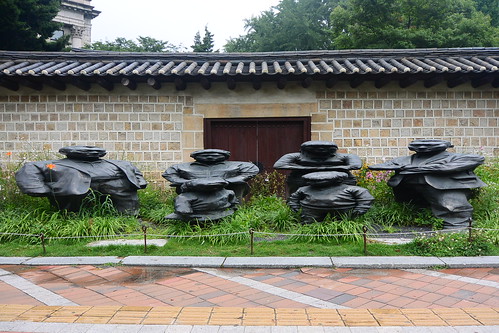
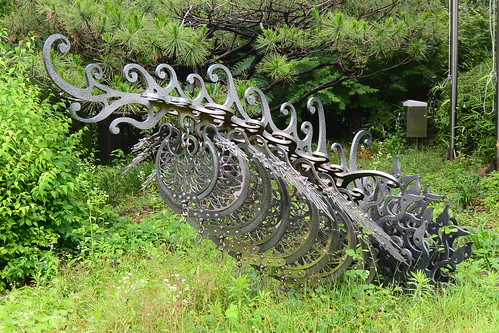
We tried to see the Seoul Museum of Art, which is reputed to have fine collections, but were stymied by an unforeseen Monday closure.  Still, the sculpture garden outside had some great pieces.

DSC_2470
DSC_2471
DSC_2469
This is one of the coolest sculptures I've ever seen.  The perspective games it plays on your
eyes are unbelievable.  Even standing right next to it, I never felt like I could get it
entirely in focus or see what was really going on.
DSC_2472
DSC_2473
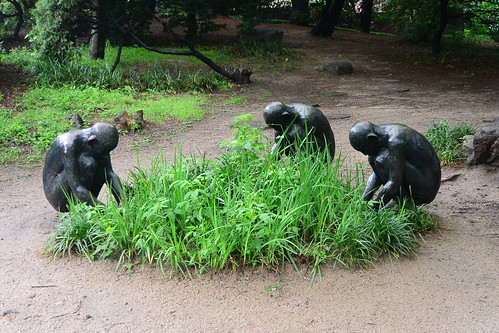
There's something a little unsettling about this one.
Are they weeding, or is there something more sinister going on?


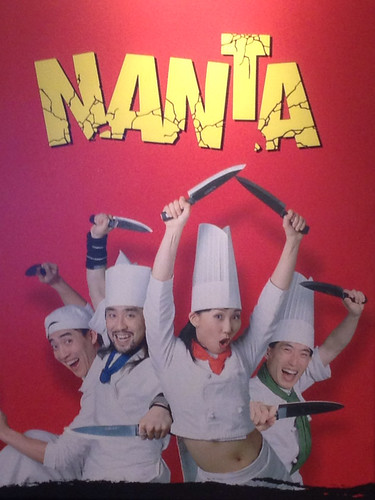
NANTA
Amanda had read about the international phenomenon that is Nanta.  Think STOMP meets Blue Man Group in the kitchen -- it's a fun, silly, crowd-pleasing show that consists of mostly wordless performance and lots of percussion.  Despite the high energy, jet lag made it difficult to stay awake.  At times more interesting than the show itself were the audience reactions:  The theatre was full of folks from all over the world (I'm assuming most were tourists like ourselves), and they were all enthralled and totally into the experience.


Untitled
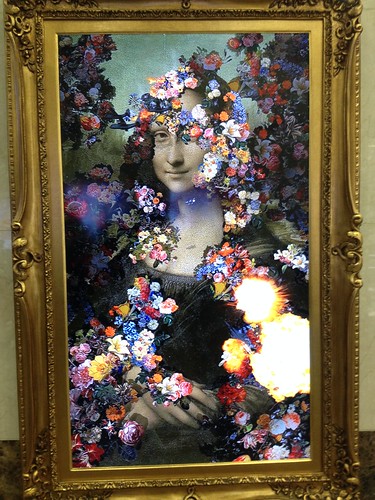
Outside the Nanta theater was this "reimagination" of the Mona Lisa.
The artist had superimposed animated bombs and planes that exploded
into flowers.  Weird.
 

Seoul (Day 1) - Monsoon!

Amanda and I have a knack for traveling to a place during the, shall we say, less than ideal time of year.  (Witness our trip through Morocco in July -- 120 degree daytime highs and Ramadan.)  We seem to have done it again this year by visiting South Korea during monsoon season.

Cindy and other locals mentioned that monsoon season had begun like two days before we got here, but they assured us that so far they hadn't really seen any of the typical rains.  Maybe, they said, you'll be lucky and the rain won't hit until after you leave!

Ha, well, that was not to be!  We left our hotel in the morning in search of breakfast under heavy skies and made it only about a block when the heavens opened.  Fortunately there was a Paris Baguette cafe nearby so we could duck out of the wet and eat some pastries.

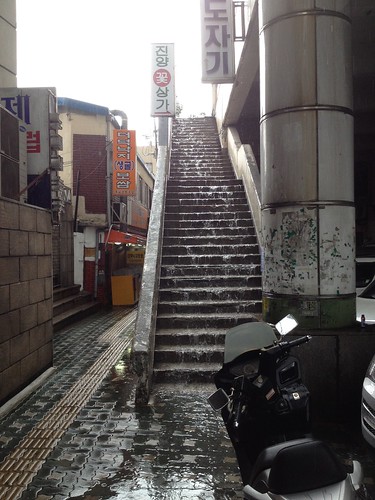
See this waterfall?  Well, that's what it looked like after the rain
had let up enough that we felt comfortable venturing out again...


That downpour lasted about 30 minutes and was only the first of many more to come.  Of course there was no point in sitting around inside until it stopped raining, so we just pulled out our raincoats and umbrellas (no Seattle anti-umbrella idiocy here!) and pressed on.  After years of living through DC summers, with their monsoon-like rainstorms, I could usually tell when the next cloudburst was about to hit -- fortunately, we were able to take shelter in some pretty interesting places when they did.

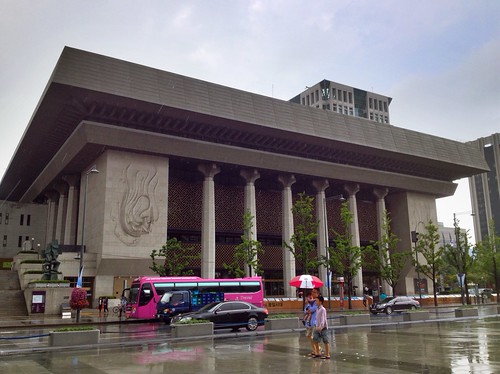
We waited out one downpour amidst the columns of this performing arts center.
We saw a poster for "Mozart das Musikal", an Austrian musical done in high-glam rock style.
 Obviously we instantly bought two tickets for tomorrow night.

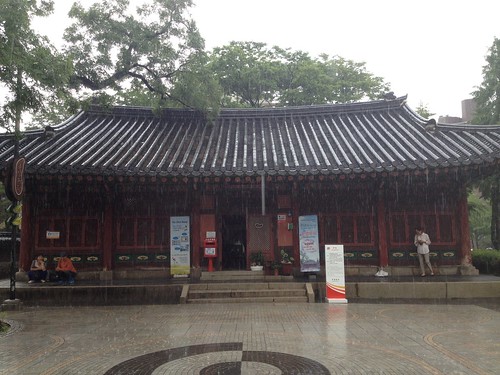
We took shelter from another downpour in a building that operated as South Korea's first
post office.  The postal system was established in the 19th Century after Korea opened
itself to the outside world.

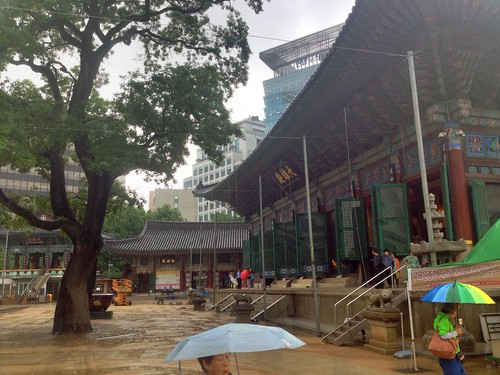
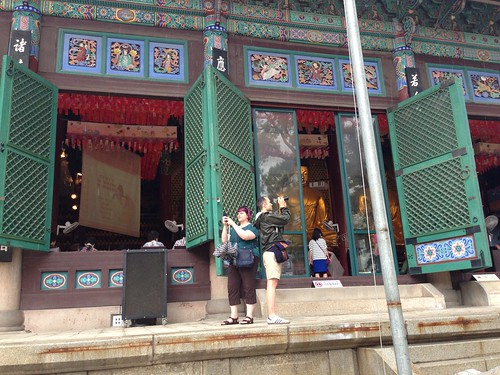
The next deluge came while we were visiting a temple complex,
so we sought refuge under the eaves.
4
And what pretty eaves they were.
After the temples, we were able to make it quite a ways before the next drencher hit.  By then we were visiting a traditional house in the Bokchun neighborhood.  We took a seat on the floor looking out on the courtyard and watched the courtyard turned into a swimming pool.  Check out the video:


DSC_2501
This is a rain spout, not a fire hydrant!

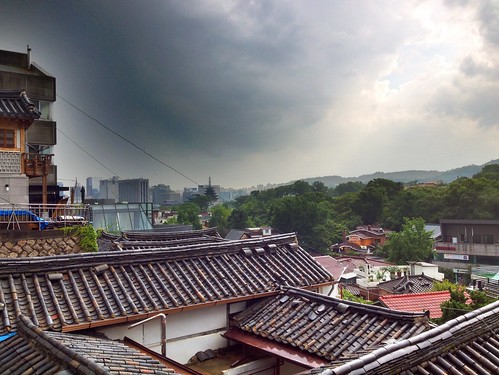
By late afternoon the volatile weather had passed by, leaving a sky filled with moody clouds and the occasional intrepid ray of sun that managed to break through.  

Farewell rain.  See you again in the morning!